Roundness and Softness in the Canter

Roundness and Softness in the Canter

During the last year I have been working on the roundness and softness of the canter with Gulipipas. When his canter doesn’t feel good, it is because the inside hind leg is not flexing enough. This results in a rough feeling under the seat and resistance against the inside rein. To the extent that the inside hind leg softens and flexes more, the canter stride becomes rounder and softer.

This made me think of Gustav Steinbrecht’s statement that the impulsion and roundness of the canter strides comes from the outside hind leg…

Don't lose sight of the whole picture

Don't lose sight of the whole picture

This week’s blog is another practical tip that comes out of mistakes I made in the past. Every time something goes wrong it is an opportunity to look more closely at what is happening, how it is happening, and why it is happening. It is a great chance to learn something new and to gain deeper insights into the biomechanical and psychological causalities in riding. So, in many ways mistakes are blessings in disguise because they can push us further along and help us attain a higher level of understanding and competence.

Transitions Into Higher Gaits

Transitions Into Higher Gaits

Transitions are always vulnerable to mistakes because the horse’s balance has to change from one gait to the next. The energy level is different in each gait. The necessary amount of core muscle engagement is different for both horse and rider. The movement is different. That’s why transitions are always prone to disturbances in the horse’s outline and rein contact. If the horse gets crooked or strung out, or if he loses balance, it will be reflected in the suppleness and the rein contact. Riding a smooth transition means managing all these different ingredients and helping the horse stay straight and in balance. That’s why so many riders and horses struggle with transitions.

Tip: Walk it before you ride it [+ VIDEO]

Tip: Walk it before you ride it [+ VIDEO]

It can be incredibly useful before you ride an exercise to get the lay of the land by walking the whole exercise on the ground. It's a common practice when memorizing dressage tests, but can be just as helpful when schooling. It lets you concentrate on what needs to happen through each phase of the exercise, to think about where the transitions are and where the hard parts may be for you or your horse so you can have more success in riding it.

Tip: Why corners matter [+ VIDEO]

Tip: Why corners matter [+ VIDEO]

The correctly ridden corner with its lateral bend forms the foundation for all bending work, i.e. all turns and lateral movements. The bend in the lateral movements is the same as in the corner. That’s why it is so important to create the best possible bend in the corner so that the lateral movement that follows on the long side or on the diagonal has the highest possible chance of success.

Tip: Activate the Inside hind leg [+ VIDEO]

Tip: Activate the Inside hind leg [+ VIDEO]

To keep your horse's energy level up and keep him lively when riding exercises which combine a number of patterns and movements, you can take advantage of your horse's reorganization of balance that occurs at the beginning of a new line (arena pattern) or change of direction. Activate the inside hind leg for a couple of strides with your inside leg or a vibration of the whip to ask the horse to pick it up a little sooner. Since he is busy rearranging his feet and his balance, he can't brace against you or use the ground against you, so the driving aid has a better chance of going through. Activating the inside hind leg in this manner allows you to enter the new line or movement with a little more power and emphasis on impulsion. Once you achieve this activation, you can become more passive for a few strides and, if necessary, repeat the request again, and if you change direction, you can activate and “speed up” the new inside hind leg.

Tip: Turn like a compass [+ VIDEO]

Tip: Turn like a compass [+ VIDEO]

In riding turns, many riders turn their heads and shoulders too far in the new direction, while their pelvis remains more or less straight. The horse, however, tends to follow the alignment of the rider’s pelvis. He will typically go where the belly button is pointing. If you want to leave the current line of travel by riding a turn, you have to indicate this by rotating your pelvis and pointing your belly button in the new direction.

Tip: Periodically video your Riding [+ VIDEO]

Tip: Periodically video your Riding [+ VIDEO]

It is really normal and common to get to a point where you feel like you aren’t making progress. You may even feel that you have slid backwards and things are getting worse. Our perspective can get so skewed. We are influenced by others we see around us. And we THINK we should be on a faster progress schedule. We THINK we aren’t making progress fast enough.

But here is the thing. Good work takes time. One of my old teachers used to always say. “Time and distance overcome the resistance.” We can take this to mean that it just takes time and really, steady work to really overcome the bigger issues.

It is about every day showing up and doing the work.
It is about paying attention to details.
It is about polishing, polishing, polishing.

But the problem with that is that when we are “down in the trenches” doing the day-to-day work, we tend to get hyper focused on the problem we are working through. And we tend to not see the progress we have made.

Michelangelo's horse and setting the statue free

Michelangelo's horse and setting the statue free

The famous Renaissance sculptor Michelangelo is credited with having said: “Every block of stone has a statue inside it and it is the task of the sculptor to discover it.” This implies “setting the statue free” by chiseling away all the rock that is not part of it. It is similar when developing the gaits of the dressage horse. Every horse has his own, unique walk, trot, and canter, as well as his own, unique piaffe and passage, which the trainer has to find and bring out, by eliminating everything that prevents the horse from moving optimally in his own, unique manner.

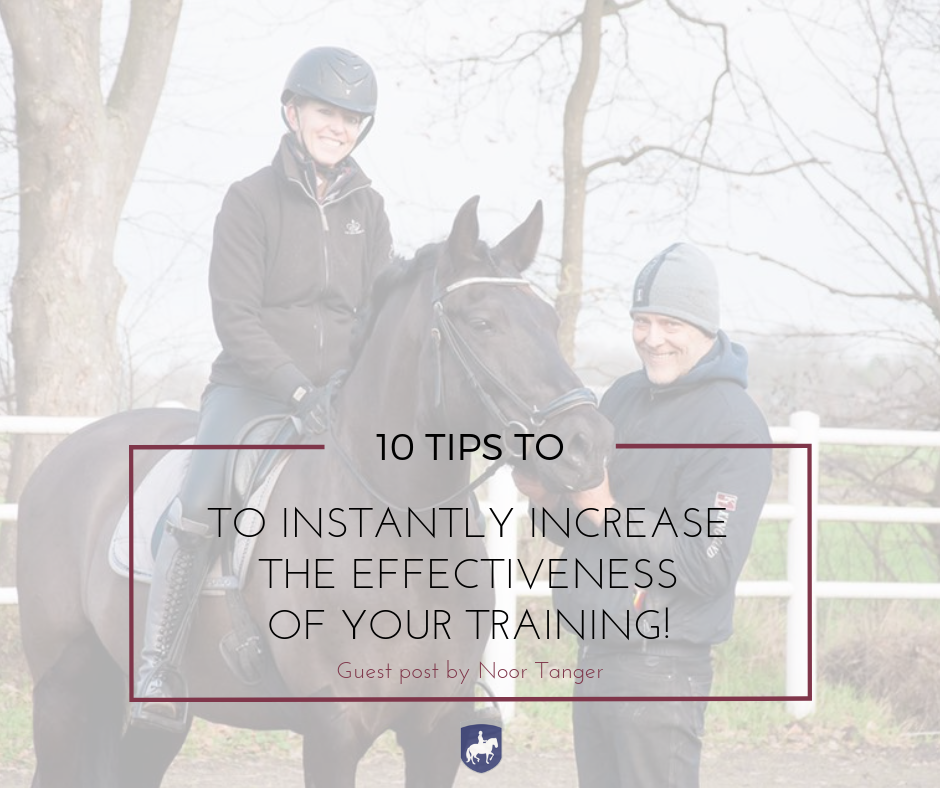
10 Tips To Instantly Increase The Effectiveness Of Your Training!

10 Tips To Instantly Increase The Effectiveness Of Your Training!

Training horses is pretty difficult, if you want to do it the right way. There’s so much you have to keep in mind at the same time to get optimal results. You are literally your horse’s fitness trainer and mental coach!

The most important thing in training should always be the well-being of your horse. Training a horse with integrity is different from forcing him into performance ‘tricks’. 

The training should always lead to an improved balance in order to prevent injuries. Tendon injuries for instance, are often a result of the horse being crooked (even a tiny bit crooked) which leads to one leg consistently carrying more weight than the others, which will increase the stress and the wear and tear on the tendons until the horse is lame. 

The same goes for problems in the back or pelvis, caused by the horse being ridden with a hollow back. That is why it is so important to do things correctly. Because I know how much time and effort it takes to train a horse well, I am happy to provide you with some tips to train more effectively.