Polishing the Pebble

Polishing the Pebble

Not everything in riding is glamorous. Not everything is special, magical, and brilliant.

Much of the most important work we do, as riders, is work that is simple - even mundane - in its simplicity. But it is where the real treasures lie.

It is one thing to teach a horse a new concept, movement, or skill set. This is important work, too, but at first, it will come with many rough edges. When you introduce it to the horse, you get it in its crude, unpolished form. It is far from “finished” and the real work unfolds from there.

Some Thoughts About Energy

Some Thoughts About Energy

Energy is not an official part of the training pyramid. It’s not really a formal category of training, although teachers will sometimes ask students to ride a more energetic walk, trot, or canter. I suspect that when teachers tell the students to “ride more forward” they often mean “create more energy”, but the word “forward” tends to lead to more speed, rather than more energy or more power.

The closest thing in the official terminology is Schwung/Impulsion, but it’s not quite the same as energy.

The Relaxed Walk at the Longe Line

The Relaxed Walk at the Longe Line

You can communicate so much in a subtle way to the horse at the walk. You can influence better the bend, carriage, size of the circle, and rhythm/tempo if you begin by establishing it at the walk. But not every horse is so keen to walk at the beginning of the work session, I know! They have to learn through gentleness, calm groundedness, and guidance. Once they learn how then it becomes a habit.

3 Tips For Improving Your Canter Departs

3 Tips For Improving Your Canter Departs

Recently, we have received a lot of questions about how you can improve the canter or the canter depart. This is obviously a major issue for many riders. This topic is very suitable for explaining the biomechanical principles behind it.

Good Rides and Bad Rides

Good Rides and Bad Rides

We have probably all had days when we felt like we had completely forgotten how to ride, when it seemed as if we couldn’t do anything right. I suspect that as long as we ride, we may never be completely safe from experiences like this. Fortunately, the incidents seem to become fewer and farther in between, the more we learn. - Or maybe we just don't take bad rides as personally anymore, because we know that we will have another good ride again soon. Just like we know after a good ride that there will be more difficult ones waiting for us in the future.

Who Are We To Judge??!

Who Are We To Judge??!

When Alois Podhajsky was the director of the Spanish Riding School in Vienna, he sometimes noticed that someone watched him during the morning workouts with a disapproving eye. So he sent his groom up to the gallery to relay the message: “The Colonel couldn’t help but notice that you disapprove of his training. He is inviting you to come down and ride his horse for him because he would love to learn a better way.” Not surprisingly, nobody was brave (or incautious) enough to take the bait and say: “By God, I’m going to get up on this horse and show him how it’s done!” That’s a very clever and very effective way to silence the peanut gallery who thinks they are so much better than the riders in the arena who are actually trying their best to do a good job with their horse.

Building a Better Relationship Through Trust and Communication

Building a Better Relationship Through Trust and Communication

In order for the horse and the rider to become the best versions of themselves and the best possible team they need to have a good relationship. The basis of this friendship between horse and rider is mutual trust, mutual respect, and effective communication. In all three areas, the burden is on the rider to prove herself to the horse, that she can be trusted, that she deserves respect, and she needs to learn to become a good communicator.

Understanding Resistance

Understanding Resistance

When I returned to riding as a middle-aged person, my first horse had a very loud ‘no.’ He was cheerful enough about doing the things he wanted to do, but my goal - to learn dressage - prompted a storm of tantrums and hissy fits of truly epic proportions. This, of course, felt horrible. He was treated well, I thought, and the requests I was making were not very difficult. So why did he spend his time looking for ways to make my life hard? Why did he keep saying ‘no’?

Mindfulness - Wherever You Go There You Are

Mindfulness  - Wherever You Go There You Are

In practising mindfulness (as with Feldenkrais) you have to bring your whole being into the process. In my opinion, this is exactly what all of us need to do in order to be a true horseman or woman.

Four reins and two bits… oh my, how do I start?

Four reins and two bits… oh my, how do I start?

So you have decided to take the leap and start using a double bridle but you want to make sure you do it correctly. We have put our collective years of experience together to give some advice to help you achieve this.

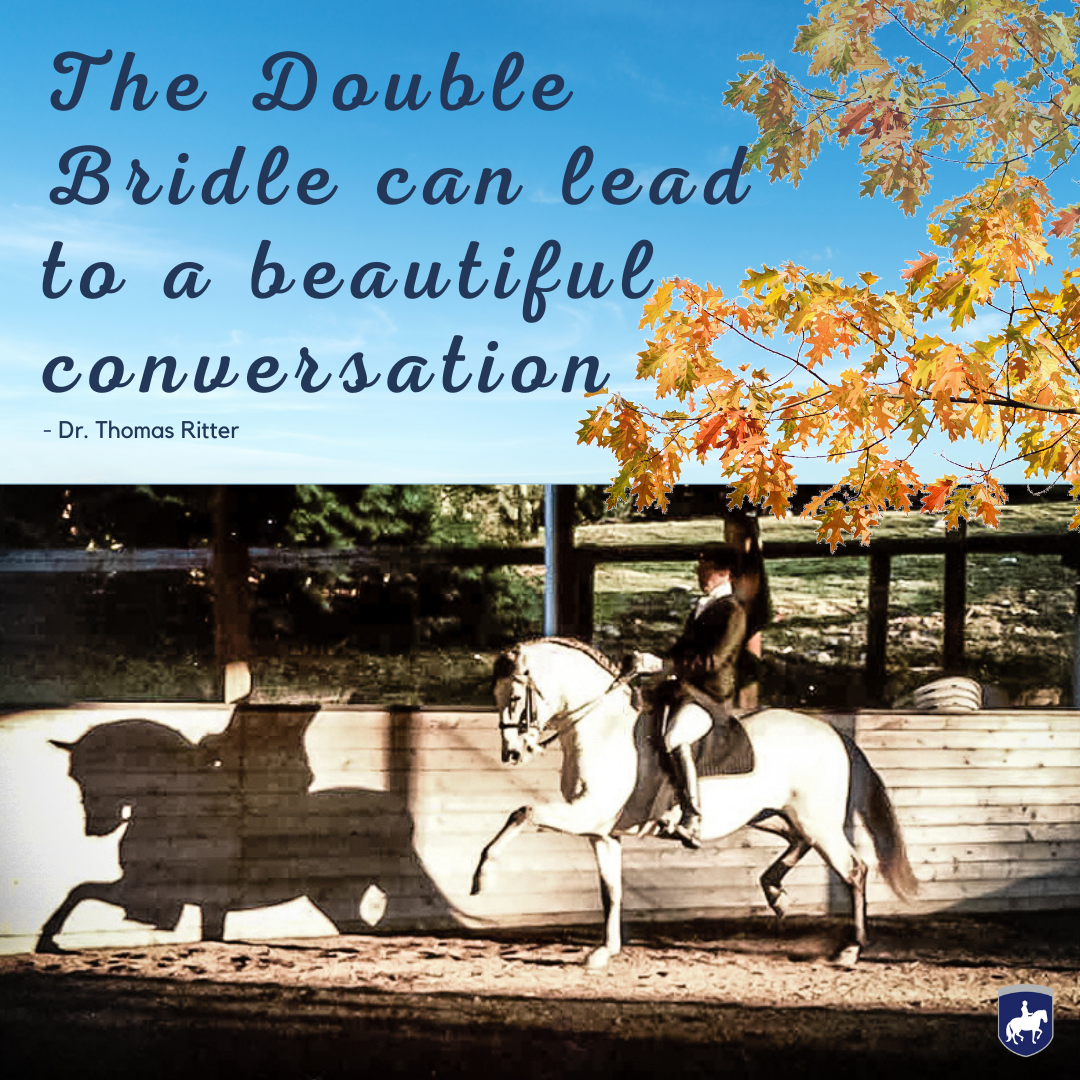
The Double Bridle can lead to a beautiful conversation

The Double Bridle can lead to a beautiful conversation

In modern dressage, the double bridle is often used as if both bits were designed identically. Most riders hold all four reins with the same tension. So the horse and rider don't get the benefit of the finesse of two bits that are designed differently and act very differently. The double bridle is not intended as a part of a costume. It is not there to get the head down. It is not there as brakes to stop your horse! In reality, the double bridle can bring a whole new dimension to the conversation with your horse.

For me, introducing the double bridle is almost like being slightly near-sighted and putting on glasses. With glasses, I can see a lot better. With a double bridle, you can feel a lot more details because you receive information through four reins and two different channels. And you can talk to the horse even more precisely than with just a snaffle.

How to set your riding goals in 2022!

How to set your riding goals in 2022!

Happy New Year! It’s time to set our 2022 Riding Goals!

The New Year is upon us yet again. I think for most of you, it would be fair to say that 2020 and 2021 may not have gone according to plan for you, but if you were creative and resourceful, you may have been able to find a way to still continue your progress and learning, in spite of the less than perfect circumstances.

Not to make light of what has been a very tough two years, but I think it is also important to take stock of what HAS gone well and why. Times like this can teach us valuable lessons such as:

✵ No one else is more responsible for your learning more than you are.

✵ You are in charge of your learning.

✵ When there is a will, there is a way.
✵ Within every problem, there is a solution.

✵ You are more capable than you may have previously realized or believed.

We Don’t Know What We Don’t Know

We Don’t Know What We Don’t Know

We don’t know what we don’t know. That can make progress difficult because we may not know what to work on, and we may not be aware of certain mistakes we make.

There are strategies, of course, with which we can discover some of the things we don’t know that we don’t know. The fastest and easiest way is to take lessons from a good teacher on a highly trained school master. Together they will let you know very quickly what is missing and what you need to work on. Unfortunately, this is not an option for most riders.

Halt Like Bach: 3 Tips For A Reliable Square Halt

Halt Like Bach:  3 Tips For A Reliable Square Halt

Many riders struggle with a square halt for years. For those who are not familiar with the term, here is a brief definition: In a square halt, you should only see two legs when looking directly from the front, from behind, or from the side. The weight should be distributed evenly on all four legs at the lower levels. At the upper levels, there should be more weight on the haunches than on the front legs.

More Forward!

More Forward!

“Ride more forward!” is probably one of the most frequent instructions dressage riders hear from their teachers. Unfortunately, riding forward is often misunderstood as riding fast (by teachers as well as students). However, true “forward” begins with the horse "thinking forward”, which means that his first instinct should be to take a step forward (not sideways or backward) whenever you apply a driving aid.