In one of our courses, a member asked a question about crookedness. She wanted to know which exercises to ride on the hollow side and the stiffer side to combat the symptoms of crookedness. There is unfortunately not a simple, straightforward answer to this because crookedness leads to imbalance on several different levels, such as…
Why Bother Straightening Your Horse?
I’m sure you are all familiar with the concept of Straightness as one of the elements of the German FN Training Scale. Those of you who are rooted in the French tradition know it as one of Alexis L’Hotte’s three main training principles (Calm, Forward, Straight). You have probably also run into its opposite - crookedness - as a tricky and quite pervasive issue. But has anybody explained to you what straightness is and why it is important? Why should you spend your entire equestrian life correcting the horse’s natural crookedness, as Jacques d’Auvergne wrote? Can’t we just go out and have fun on our horse?
Mindfulness - Wherever You Go There You Are
Four reins and two bits… oh my, how do I start?
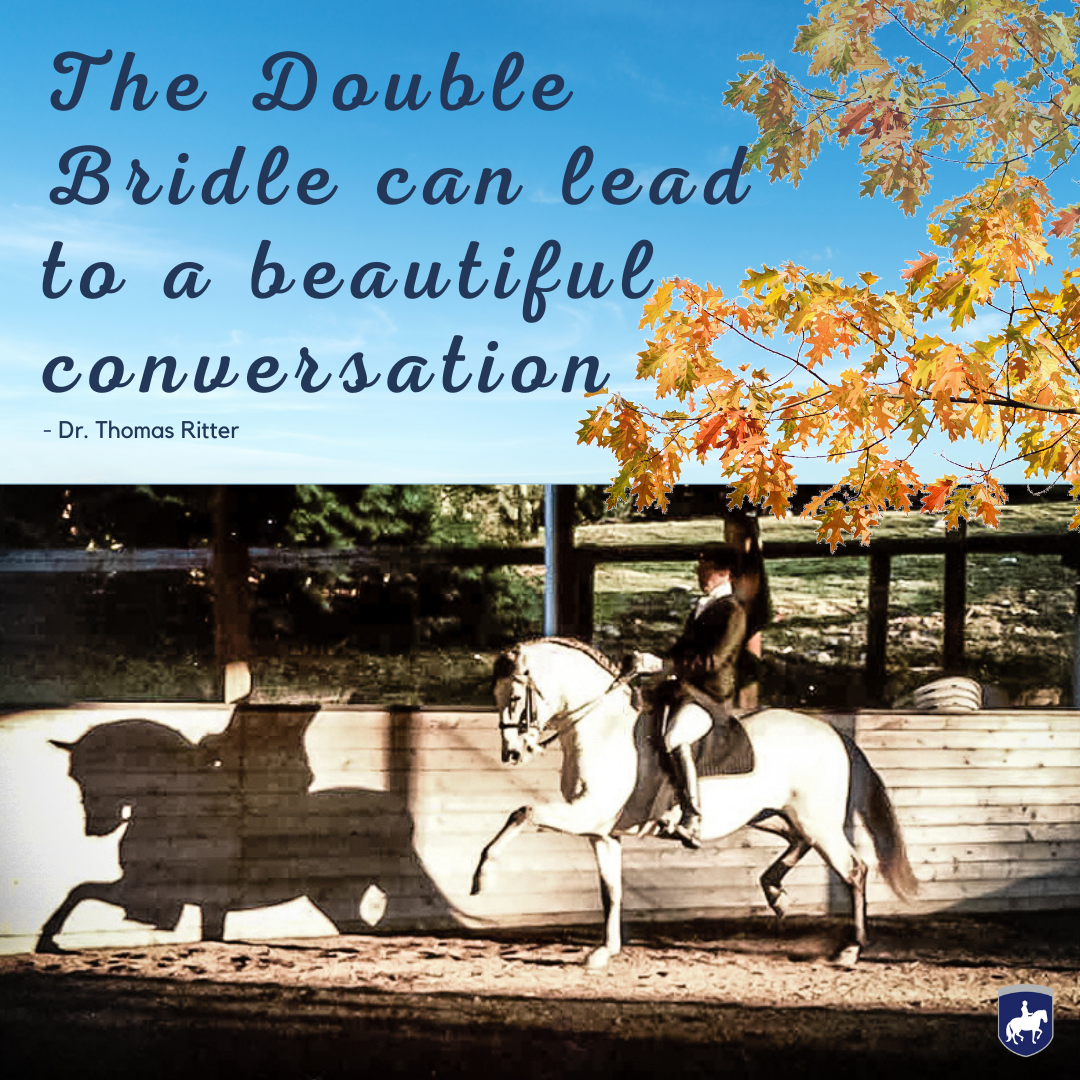
The Double Bridle can lead to a beautiful conversation
In modern dressage, the double bridle is often used as if both bits were designed identically. Most riders hold all four reins with the same tension. So the horse and rider don't get the benefit of the finesse of two bits that are designed differently and act very differently. The double bridle is not intended as a part of a costume. It is not there to get the head down. It is not there as brakes to stop your horse! In reality, the double bridle can bring a whole new dimension to the conversation with your horse.
For me, introducing the double bridle is almost like being slightly near-sighted and putting on glasses. With glasses, I can see a lot better. With a double bridle, you can feel a lot more details because you receive information through four reins and two different channels. And you can talk to the horse even more precisely than with just a snaffle.
When a Flying Change Fails
When a flying change fails, the reason is usually that the horse became crooked and/or fell on the forehand. This results in a loss of the connection between the inside hind leg, the ground, the rider’s weight, and the reins which prevents the half halts from going through. That’s why things generally don’t improve if you keep cantering and keep repeating the aids for the flying changes.
It saves much time, sweat, and aggravation for both horse and rider, if you interrupt what you’re doing, bring the horse back to the trot or walk, or even to the halt, straighten and balance the horse, check his body for stiff, braced areas, remove the muscle blockages, and re-explain the biomechanics of the flying change (i.e. shift the weight, change the bend, move the pelvis).
As the horse is developing his conscious competence, he will often need time to think and to plan his next move so that he can perform the task deliberately. As he moves from conscious competence to unconscious competence, he can do flying changes anywhere, any time, with less and less preparation.

Halt Like Bach: 3 Tips For A Reliable Square Halt
Many riders struggle with a square halt for years. For those who are not familiar with the term, here is a brief definition: In a square halt, you should only see two legs when looking directly from the front, from behind, or from the side. The weight should be distributed evenly on all four legs at the lower levels. At the upper levels, there should be more weight on the haunches than on the front legs.
More Forward!
“Ride more forward!” is probably one of the most frequent instructions dressage riders hear from their teachers. Unfortunately, riding forward is often misunderstood as riding fast (by teachers as well as students). However, true “forward” begins with the horse "thinking forward”, which means that his first instinct should be to take a step forward (not sideways or backward) whenever you apply a driving aid.
Roundness and Softness in the Canter
During the last year I have been working on the roundness and softness of the canter with Gulipipas. When his canter doesn’t feel good, it is because the inside hind leg is not flexing enough. This results in a rough feeling under the seat and resistance against the inside rein. To the extent that the inside hind leg softens and flexes more, the canter stride becomes rounder and softer.
This made me think of Gustav Steinbrecht’s statement that the impulsion and roundness of the canter strides comes from the outside hind leg…
A New Way of Looking at the Training Scale
My understanding of the training scale is constantly evolving and changing, based on my practical experiences and observations. The first time I heard about the Training Scale (Skala der Ausbildung) was during theory lessons for the German Bronze medal, which is the prerequisite for participating in recognised shows. For the exam we had to memorize the terms Takt (rhythm), Losgelassenheit (relaxation/suppleness), Anlehnung (rein contact), Geraderichten (straightness), Schwung (impulsion), and Versammlung (collection). - And that was pretty much it. There wasn’t really any explanation for what these terms or concepts were about, or what the relationship between them was. We only had to be able to name them and to tell how to recognise them.
Don't lose sight of the whole picture
This week’s blog is another practical tip that comes out of mistakes I made in the past. Every time something goes wrong it is an opportunity to look more closely at what is happening, how it is happening, and why it is happening. It is a great chance to learn something new and to gain deeper insights into the biomechanical and psychological causalities in riding. So, in many ways mistakes are blessings in disguise because they can push us further along and help us attain a higher level of understanding and competence.
Self Carriage, Balance, and Lightness
We are often asked how to get a horse light in hand and off of the forehand when he is leaning heavily on the bridle. Both issues are closely related to each other. The rein contact that the horse offers is not a localised affair that is limited to the rider’s hand and the horse’s mouth. It is, rather, the result of the horse’s balance, overall posture, and muscle development. That’s why it usually doesn’t help to change bits, because the underlying causes are located somewhere else.
Connection(s) And Throughness
Connection(s) and throughness is actually a rather large topic on which you could write a whole book because there are several different aspects to it that you can explain in great detail. There are many different connections that have to be established between the rider’s aids and the horse’s body, between the horse’s legs and the ground, as well as between the different parts of the horse’s body. With each new connection, the energy of the horse’s hind legs can travel more freely through his body and the permeability for the aids increases. Every time a connection is lost, the permeability diminishes and the movement impulses of the hind legs as well as the rider’s aids get stuck.
Dressage Movements As Points On A Continuum
Many dressage riders view the movements in very absolute terms, based on the definitions in the FEI rule book. When someone rides a movement, like a shoulder-in for instance, it either fulfils these criteria or it doesn’t. In other words, it either IS a shoulder-in or it’s NOT. This is very much a judge’s viewpoint, which is valid in competitions and exhibitions. However, in training, I take a more fluid approach. I prefer to look at movements as points on a continuum because it’s unrealistic to expect a horse or a rider to be able to perform a perfect shoulder-in or half pass, the first time they try it. So, we as trainers and teachers have to build a road, or a staircase for the student to get from where they are to the finished product. This means we have to set priorities in the way we teach movements and approach the end goal in many small learning steps. If we aimed for perfection or demanded perfection at the first attempt, we would set the horse and the rider up for failure, stress, and frustration.
Setting priorities means ignoring certain imperfections for the time being because they have a lower priority than other aspects of the movement.
The Historical Development Of Elevating From A Low Head Position
Looking at the development of equestrian art over longer periods of time, you will detect pendulum-like swings of opinions in many areas. There are fashion trends that are taken to a certain extreme. Then, opinions change, and the pendulum swings in the opposite direction until it reaches the other extreme. Although these developments are often based on correct observations in some areas, extremes are usually counter productive and often damage the horse’s soundness and overall health. It is always dangerous when an observation of one training aspect is made the only criterion for evaluating training progress and then taken to an extreme, following the motto: more is better.
One example of such extremes are two diametrically opposed opinions on riding long and low. On one end of the spectrum are those riders for whom stretching forward-downward is the highest goal of dressage training and the solution to all problems. Many of them believe that you are not allowed to do anything else in the training of your horse until the horse is able to stretch forward-downward. On the opposite end of the spectrum are those who categorically reject any and all forward-downward stretching because they believe that it puts the horse onto the forehand and ruins the horse’s legs.