When I wrote this article we were travelling through Germany and Austria by car for a mixture of work and vacation. We combined fun things for the kids with some teaching and business meetings. During the longer road trips we tend to like to listen to a variety of podcasts. The day before I wrote this article, we were listening to the latest edition of Marc Maron’s WTF podcast in which he interviews Alice Cooper, the rock star.
Curiosity and Creativity in Learning Dressage
We all want to learn to ride. That makes us curious. Curiosity leads to questions like: “How does this work?”, “How do I need to sit?”, “How do I ride a shoulder-in?”, “How do I teach a piaffe?”, etc.
In pursuit of these questions, we take lessons, read books, and watch videos in the hopes of finding answers. Over the last 30 years the amount of equestrian literature has vastly proliferated, so that you can find many different publications to choose from on most topics. So far, so good.
The danger is that there is a long tradition in the history of dressage to believe that there is only one true and correct way of riding and training. Everyone believes that THEIR way is the one and only RIGHT way, and that everyone else is, therefore, wrong.
Michelangelo's horse and setting the statue free
The famous Renaissance sculptor Michelangelo is credited with having said: “Every block of stone has a statue inside it and it is the task of the sculptor to discover it.” This implies “setting the statue free” by chiseling away all the rock that is not part of it. It is similar when developing the gaits of the dressage horse. Every horse has his own, unique walk, trot, and canter, as well as his own, unique piaffe and passage, which the trainer has to find and bring out, by eliminating everything that prevents the horse from moving optimally in his own, unique manner.
Developing the Horse’s Body Awareness
Yesterday I worked with Patrick and Solo, his Kladruber gelding. It was a lesson about developing the horse’s body awareness and connecting the horse’s feet to the ground and to the weight. Over the years I noticed that many horses don’t have good body awareness. They don’t seem to know exactly how many legs they have, or where they are. It always reminds me of quantum physics. If you know where a particle is, you don’t know where or how fast it is moving, and if you know where and how fast it is moving, you don’t know where it is. Horse’s legs are sometimes a little like that, too.
Developing Pushing Power in the Hindquarters
Where are we and what are we doing today?
We are visiting Noor Tanger and Patrick Molenaar in the Netherlands for a few days.
I worked with Noor Tanger and her PRE Stallion Oclajoma on developing power in the hindquarters, especially pushing power. We explained to him that he can put more energy into the walk, trot, or canter, without getting faster, and that he can slow down the tempo without going to sleep. These are not intuitively logical concepts for most horses, but they have to learn that a driving aid does not mean “go faster”, and a half halt doesn’t mean “take a break”. Tempo, stride length, and energy level are different parameters of the gait that can be adjusted separately.
The Circle of the Aids
The circle of aids is an important concept in the rider’s training. It refers to the flow of energy within the horse and to the way the rider’s aids stimulate and channel this flow.
The circle of aids typically begins with a driving calf aid that brings the horse’s hind legs closer to the center of gravity and into the sphere of influence of the seat. If the hind legs are too far out behind, they are out of reach for the seat and the horse’s back drops. Trying to apply any seat aid at that moment will make the situation worse. It will cause the back to drop - and hurt - even more, and the hind legs will then actually be prevented from stepping under by the weight aid.
The "HOW" of Learning Rider Feel - Part 4 of 4
So what IS Feldenkrais? And how can YOU use it in YOUR riding? Very simply Feldenkrais lessons refine your ability to ‘listen’ to the information from your senses that lets you know the quality of your balance, breathing, posture and movement. It is this ability to pay attention to the subtle nuances of your sensory feedback mechanism that makes the difference between the effortless co-ordination of great riders and expending too much energy for the job in hand.
As a rider, it can help you to recognise and inhibit the unhelpful muscular efforts that interfere with your performance. You will become more discerning and improve your sensitivity, so you can respond quickly and easily to your horse. You will become quicker at identifying how to adjust any part of your body so you can ride how you’ve always wanted to. If you want to experience this now try this short Feldenkrais lesson…
The "HOW" of Learning Rider Feel - Part 3 of 4
Recently I was out on a hack with a friend. She was asking about Feldenkrais and how it applied to riding. She had observed me having lessons with my trainer and was struck by my ability to easily move my body in a particular direction or with a certain quality.
I explained that Feldenkrais lessons improve the quality of our action and that we can apply the experience of moving better to our riding. She looked puzzled.
The "HOW" of Learning Rider Feel - Part 2 of 4
In my last blog I described how I got to a pretty low point in my horse-owning journey. Before Shana’s email dropped into my inbox, I had felt compelled to have lessons with one of the yard staff because it seemed easier to fall in line with their wishes rather than to be on the receiving end of their sniping or criticisms whenever the classical trainer that I wanted to work with came onto the yard. I had also surreptitiously signed up to a couple of online trainings with people who seemed to have a similar philosophy to my own, but I was not having any success in translating their teachings into my riding. I was at the point where I would sail down the school on the right rein, trying to apply what I’d learnt online about steering, but with no positive result whatsoever. I was frequently to be spotted stuck in the corner of the school while my horse ate the hedge. Amusing though this was - and I do have the capacity to laugh at myself - this only served to contribute further to my feelings of inadequacy and embarrassment.
The "HOW" of Learning Rider Feel - Part 1 of 4
There’s nothing like the feeling when everything comes together and you are totally at one with your mind and body. When I’m in that state, where the lightest of intentions turns into effortless action, it’s the most exhilarating feeling imaginable. Some people call it being in a state of flow, but I think of it as being ‘in the zone’. When I’m in the zone, I feel completely in balance, I feel strong yet light and, most importantly, I have this immense sense of freedom that allows me to be totally spontaneous.
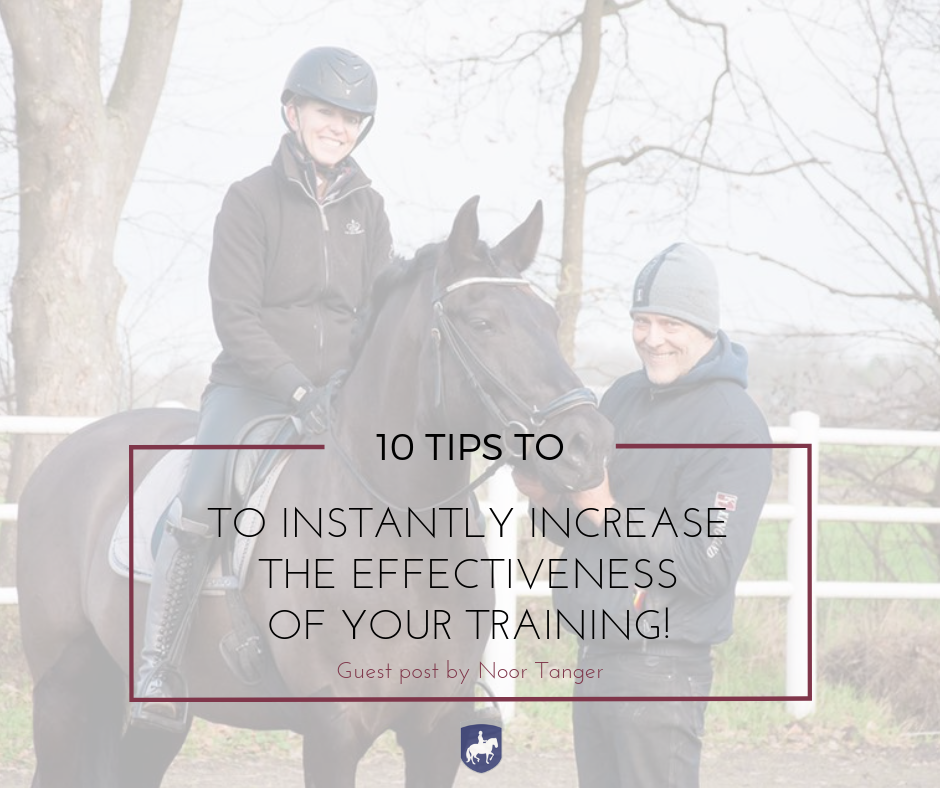
10 Tips To Instantly Increase The Effectiveness Of Your Training!
Training horses is pretty difficult, if you want to do it the right way. There’s so much you have to keep in mind at the same time to get optimal results. You are literally your horse’s fitness trainer and mental coach!
The most important thing in training should always be the well-being of your horse. Training a horse with integrity is different from forcing him into performance ‘tricks’.
The training should always lead to an improved balance in order to prevent injuries. Tendon injuries for instance, are often a result of the horse being crooked (even a tiny bit crooked) which leads to one leg consistently carrying more weight than the others, which will increase the stress and the wear and tear on the tendons until the horse is lame.
The same goes for problems in the back or pelvis, caused by the horse being ridden with a hollow back. That is why it is so important to do things correctly. Because I know how much time and effort it takes to train a horse well, I am happy to provide you with some tips to train more effectively.
Core Stability
A member asked a question about core stability on the Artistic Dressage page. I was struck by the huge variety in understanding of what the core is, which got me thinking about how you might access your core in a way that could be effective in riding, as well as in daily life. So in my ride today I decided to pay very close attention to how I keep myself in balance and report my findings back here. I’m not the greatest or most experienced rider, however many years of teaching Feldenkrais, movement and sport has given me a relatively refined sense of how I’m moving at any point in time.
Dressage As Physiotherapy, Part 2
Balance, Straightness, and Suppleness. These three concepts are very closely connected, as I described in the first part of this two part series. Balance consists of the two aspects of longitudinal balance and lateral balance. Longitudinal balance (i.e. an even weight distribution between front legs and hind legs) develops out of a regular tempo that is neither too fast nor too slow.
Lateral balance is the ability to distribute the weight evenly between the left pair of legs and the right pair of legs, or to transfer it more to one lateral pair or the other.
Balance is not rigid or static, as in a statue. It’s dynamic. This means that the horse is able to shift his weight from one lateral pair of legs to the other, from the front legs to the hind legs, or from one diagonal pair of legs to the other.
Dressage as Physiotherapy [VIDEO]
Dressage as Physiotherapy, Part 1
Horses were not designed to carry somebody on their back. The presence of the rider’s weight therefore compromises the horse’s balance, at least at first. It changes the center of gravity, and it may inhibit the freedom of motion of the spine and the legs. If the horse feels impeded and out of balance because of the rider’s presence on his back, he will contract certain muscles and brace against the rider’s weight and the ground, which leads to unhealthy movement patterns. Muscular contractions diminish the range of motion of the affected joints, and they lead to a hard, jarring impact of the legs on the ground, which is not only uncomfortable for the rider as well as the horse, it also creates unnecessary wear and tear on the horse’s joints and tendons.
If we want to keep the horse sound we therefore have to counteract the negative effects of our weight. We need to enable the horse to move with the same freedom of motion, the same ease, the same balance, the same suppleness under the weight of the rider with which he moves at liberty.


![Dressage as Physiotherapy [VIDEO]](https://images.squarespace-cdn.com/content/v1/59a02416e9bfdf2c7103cfcd/1550417569361-VBXOK45Q7DLQCOHJZFJX/Dressage+as+Physiotherapy.png)