The Double Bridle can lead to a beautiful conversation

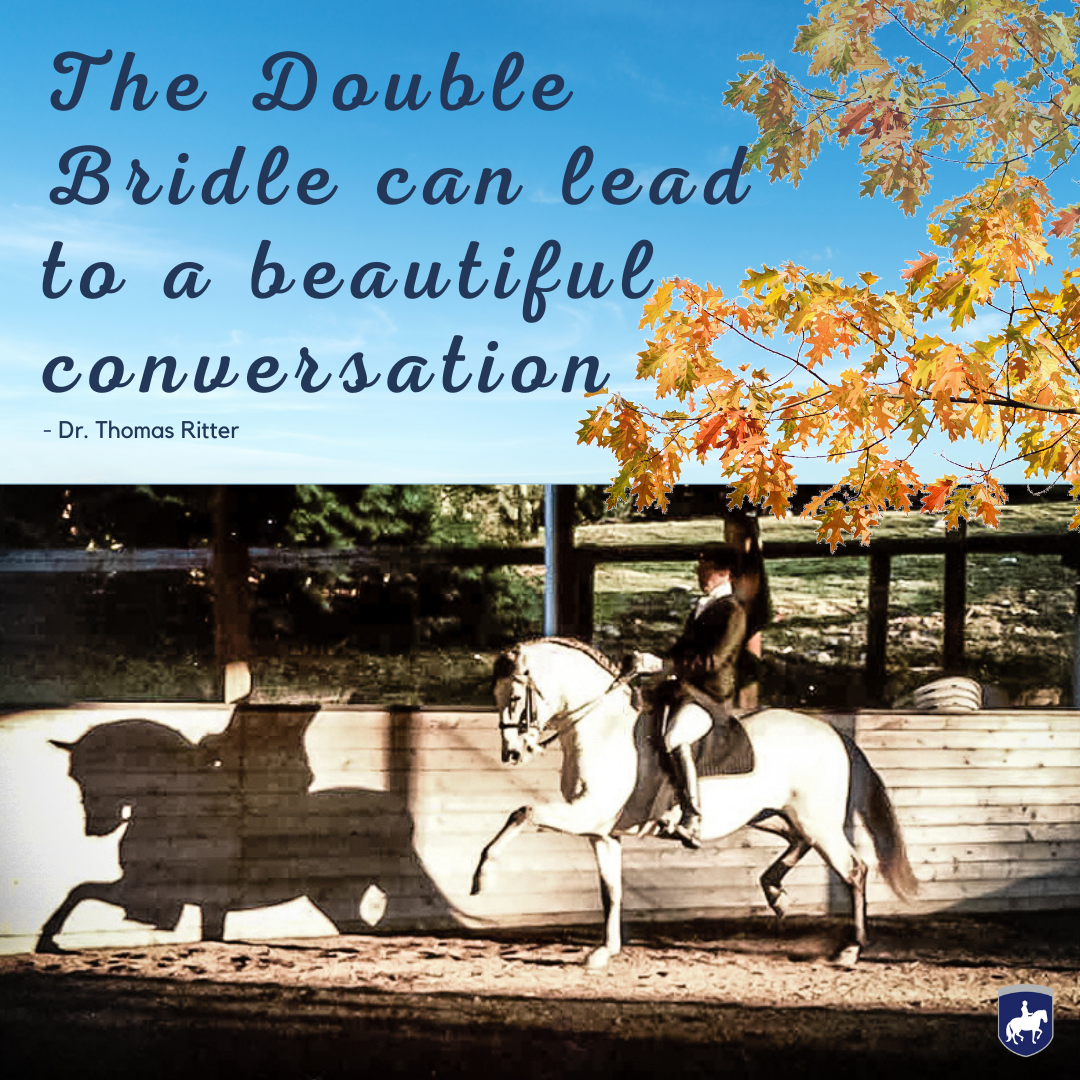
The Double Bridle can lead to a beautiful conversation

In modern dressage, the double bridle is often used as if both bits were designed identically. Most riders hold all four reins with the same tension. So the horse and rider don't get the benefit of the finesse of two bits that are designed differently and act very differently. The double bridle is not intended as a part of a costume. It is not there to get the head down. It is not there as brakes to stop your horse! In reality, the double bridle can bring a whole new dimension to the conversation with your horse.

For me, introducing the double bridle is almost like being slightly near-sighted and putting on glasses. With glasses, I can see a lot better. With a double bridle, you can feel a lot more details because you receive information through four reins and two different channels. And you can talk to the horse even more precisely than with just a snaffle.

When a Flying Change Fails

When a Flying Change Fails

When a flying change fails, the reason is usually that the horse became crooked and/or fell on the forehand. This results in a loss of the connection between the inside hind leg, the ground, the rider’s weight, and the reins which prevents the half halts from going through. That’s why things generally don’t improve if you keep cantering and keep repeating the aids for the flying changes.

It saves much time, sweat, and aggravation for both horse and rider, if you interrupt what you’re doing, bring the horse back to the trot or walk, or even to the halt, straighten and balance the horse, check his body for stiff, braced areas, remove the muscle blockages, and re-explain the biomechanics of the flying change (i.e. shift the weight, change the bend, move the pelvis).


As the horse is developing his conscious competence, he will often need time to think and to plan his next move so that he can perform the task deliberately. As he moves from conscious competence to unconscious competence, he can do flying changes anywhere, any time, with less and less preparation.

How to set your riding goals in 2022!

How to set your riding goals in 2022!

Happy New Year! It’s time to set our 2022 Riding Goals!

The New Year is upon us yet again. I think for most of you, it would be fair to say that 2020 and 2021 may not have gone according to plan for you, but if you were creative and resourceful, you may have been able to find a way to still continue your progress and learning, in spite of the less than perfect circumstances.

Not to make light of what has been a very tough two years, but I think it is also important to take stock of what HAS gone well and why. Times like this can teach us valuable lessons such as:

✵ No one else is more responsible for your learning more than you are.

✵ You are in charge of your learning.

✵ When there is a will, there is a way.
✵ Within every problem, there is a solution.

✵ You are more capable than you may have previously realized or believed.

We Don’t Know What We Don’t Know

We Don’t Know What We Don’t Know

We don’t know what we don’t know. That can make progress difficult because we may not know what to work on, and we may not be aware of certain mistakes we make.

There are strategies, of course, with which we can discover some of the things we don’t know that we don’t know. The fastest and easiest way is to take lessons from a good teacher on a highly trained school master. Together they will let you know very quickly what is missing and what you need to work on. Unfortunately, this is not an option for most riders.

Halt Like Bach: 3 Tips For A Reliable Square Halt

Halt Like Bach:  3 Tips For A Reliable Square Halt

Many riders struggle with a square halt for years. For those who are not familiar with the term, here is a brief definition: In a square halt, you should only see two legs when looking directly from the front, from behind, or from the side. The weight should be distributed evenly on all four legs at the lower levels. At the upper levels, there should be more weight on the haunches than on the front legs.

Deep Seat - Light Seat

Deep Seat - Light Seat

You have probably all heard that one of the qualities of a good seat is that it is deep. But what does that mean? For me personally, a deep seat is a seat with a low center of gravity and the largest possible area of support. This lends the seat stability and it allows the rider to feel the horse with her entire body, which is why the old masters used to say that the rider should sit “in” the horse, rather than “on” or “over” the horse. A seat with a high center of gravity and a small support base, on the other hand, is unstable and doesn’t allow the rider to feel the horse very well.

More Forward!

More Forward!

“Ride more forward!” is probably one of the most frequent instructions dressage riders hear from their teachers. Unfortunately, riding forward is often misunderstood as riding fast (by teachers as well as students). However, true “forward” begins with the horse "thinking forward”, which means that his first instinct should be to take a step forward (not sideways or backward) whenever you apply a driving aid.

Roundness and Softness in the Canter

Roundness and Softness in the Canter

During the last year I have been working on the roundness and softness of the canter with Gulipipas. When his canter doesn’t feel good, it is because the inside hind leg is not flexing enough. This results in a rough feeling under the seat and resistance against the inside rein. To the extent that the inside hind leg softens and flexes more, the canter stride becomes rounder and softer.

This made me think of Gustav Steinbrecht’s statement that the impulsion and roundness of the canter strides comes from the outside hind leg…

Dynamic Seat vs. Static Seat

Dynamic Seat vs. Static Seat

Lately I have been thinking a lot about the fact that traditional seat descriptions and discussions of the seat often seem to treat the seat as something static that doesn’t move. Sitting still, having a quiet seat is often considered to be the ideal. Traditional seat instruction is often rather static as well: always sit on the inside seat bone, always have the inside hip more forward and the outside hip more back….

Unfortunately, the emphasis on stillness and on always sitting exactly the same way - whether the horse needs it or not - can lead to stiffness in the rider’s seat, which will in turn create stiffness in the horse’s body and interfere with the horse’s freedom of movement.

Why the Seat is so important for the canter

Why the Seat is so important for the canter

The seat is always important in our riding. It plays an important role in everything we do, but in the canter, it is even more important than in the walk and trot. Due to the bigger movement in the canter, the rider’s seat gets challenged more than in the walk and trot, and the horse often needs more support from the rider’s seat in the canter in order to keep their balance.

A New Way of Looking at the Training Scale

A New Way of Looking at the Training Scale

My understanding of the training scale is constantly evolving and changing, based on my practical experiences and observations. The first time I heard about the Training Scale (Skala der Ausbildung) was during theory lessons for the German Bronze medal, which is the prerequisite for participating in recognised shows. For the exam we had to memorize the terms Takt (rhythm), Losgelassenheit (relaxation/suppleness), Anlehnung (rein contact), Geraderichten (straightness), Schwung (impulsion), and Versammlung (collection). - And that was pretty much it. There wasn’t really any explanation for what these terms or concepts were about, or what the relationship between them was. We only had to be able to name them and to tell how to recognise them.

Don't lose sight of the whole picture

Don't lose sight of the whole picture

This week’s blog is another practical tip that comes out of mistakes I made in the past. Every time something goes wrong it is an opportunity to look more closely at what is happening, how it is happening, and why it is happening. It is a great chance to learn something new and to gain deeper insights into the biomechanical and psychological causalities in riding. So, in many ways mistakes are blessings in disguise because they can push us further along and help us attain a higher level of understanding and competence.

Mouth and Tongue Issues

Mouth and Tongue Issues

I recently received an email from a lady with a question about a tongue issue that her horse had all his life. His tongue often comes out of the front of his mouth, c. 4cm, and goes back in, almost like a snake’s. It sounds like a licking motion. He has a tendency to worry and to get distracted.

Since I don’t know the rider or the horse my advice had to be relatively general, suggesting several possible causes for this phenomenon that she can investigate on her own. And then I thought that this might be an interesting topic for others as well because mouth and tongue issues are not uncommon, and they can be caused by a variety of factors.

Self Carriage, Balance, and Lightness

Self Carriage, Balance, and Lightness

We are often asked how to get a horse light in hand and off of the forehand when he is leaning heavily on the bridle. Both issues are closely related to each other. The rein contact that the horse offers is not a localised affair that is limited to the rider’s hand and the horse’s mouth. It is, rather, the result of the horse’s balance, overall posture, and muscle development. That’s why it usually doesn’t help to change bits, because the underlying causes are located somewhere else.

Connection(s) And Throughness

Connection(s) And Throughness

Connection(s) and throughness is actually a rather large topic on which you could write a whole book because there are several different aspects to it that you can explain in great detail. There are many different connections that have to be established between the rider’s aids and the horse’s body, between the horse’s legs and the ground, as well as between the different parts of the horse’s body. With each new connection, the energy of the horse’s hind legs can travel more freely through his body and the permeability for the aids increases. Every time a connection is lost, the permeability diminishes and the movement impulses of the hind legs as well as the rider’s aids get stuck.