Good Rides and Bad Rides

Good Rides and Bad Rides

We have probably all had days when we felt like we had completely forgotten how to ride, when it seemed as if we couldn’t do anything right. I suspect that as long as we ride, we may never be completely safe from experiences like this. Fortunately, the incidents seem to become fewer and farther in between, the more we learn. - Or maybe we just don't take bad rides as personally any more, because we know that we will have another good ride again soon. Just like we know after a good ride that there will be more difficult ones waiting for us in the future.

Why does my horse invert in transitions?

Why does my horse invert in transitions?

If the horse inverts in transitions, there are several possible causes. Some of them have to do with the horse, some of them have more to do with the rider. Transitions are always susceptible to mistakes because the footfall and the balance have to change.

Using A Lateral Movement Vs. Performing It

Using A Lateral Movement Vs. Performing It

There is a general tendency among dressage riders to have a somewhat rigid view of lateral movements and to evaluate them only as a judge in a competition would do. There is also a tendency to ride lateral movements mostly down the long side of the arena, and to stay in the movement for the entire long side. And while there is nothing wrong with that, it is only scratching the surface of the gymnastic potential of lateral movements. These movements were not (only) invented to evaluate a horse’s training, but they also have very valuable gymnastic properties that can be used to improve the horse’s balance, straightness, suppleness, and collectability.

Ask The Right Questions

Ask The Right Questions

This week I want to touch on something that is very important in training and riding, but unfortunately, it is hardly ever addressed in lessons or in books and magazine articles. It has to do with training strategies. How do you decide how to proceed next with your horse? How do you know how to improve a movement, a transition, a turn, the rein contact, the horse’s suppleness, or any other problem you may encounter? Many good, experienced riders make these decisions purely intuitively, based on their gut feeling and their experience with many different horses, and these riders are very often correct in their decisions. But this kind of skill is unfortunately difficult to communicate and to pass on to others.

Transitions, Transitions: Simple, but not easy

Transitions, Transitions: Simple, but not easy

The way the horse performs transitions to the halt and from the halt tells us a lot about his training. Many horses and riders struggle with these transitions. Half halts often don’t go through in down transitions, so the horse inverts or curls up. The halt isn’t square, the horse is crooked, to name just some of the most common problems.

Dissolving Resistances

Dissolving Resistances

In my own practical experience, I have often observed that resistances in the poll and resistances in the hindquarters tend to go hand in hand, so in order to overcome the problem we need to address the poll as well as the hip.

How To Improve The Horse’s Straightness In The Shoulder-in

How To Improve The Horse’s Straightness In The Shoulder-in

This is a great discussion of how a thinking rider can correct the horse’s attempts to evade the demands of the shoulder-in by using the other lateral movements to bring both hind legs underneath the body. This somewhat indirect approach is much more effective than trying to create the correct bend by pulling on the inside rein, or trying to create a contact on the outside rein by using “more inside leg and more outside rein”, which are so often the standard recommendations of trainers. These direct approaches actually only make the problem worse, whereas the indirect approach teaches the horse better body awareness and it makes the hind legs stronger and more supple, so that he is able to perform a correct shoulder-in easily and without feeling the need to evade.

Through the Back

Through the Back

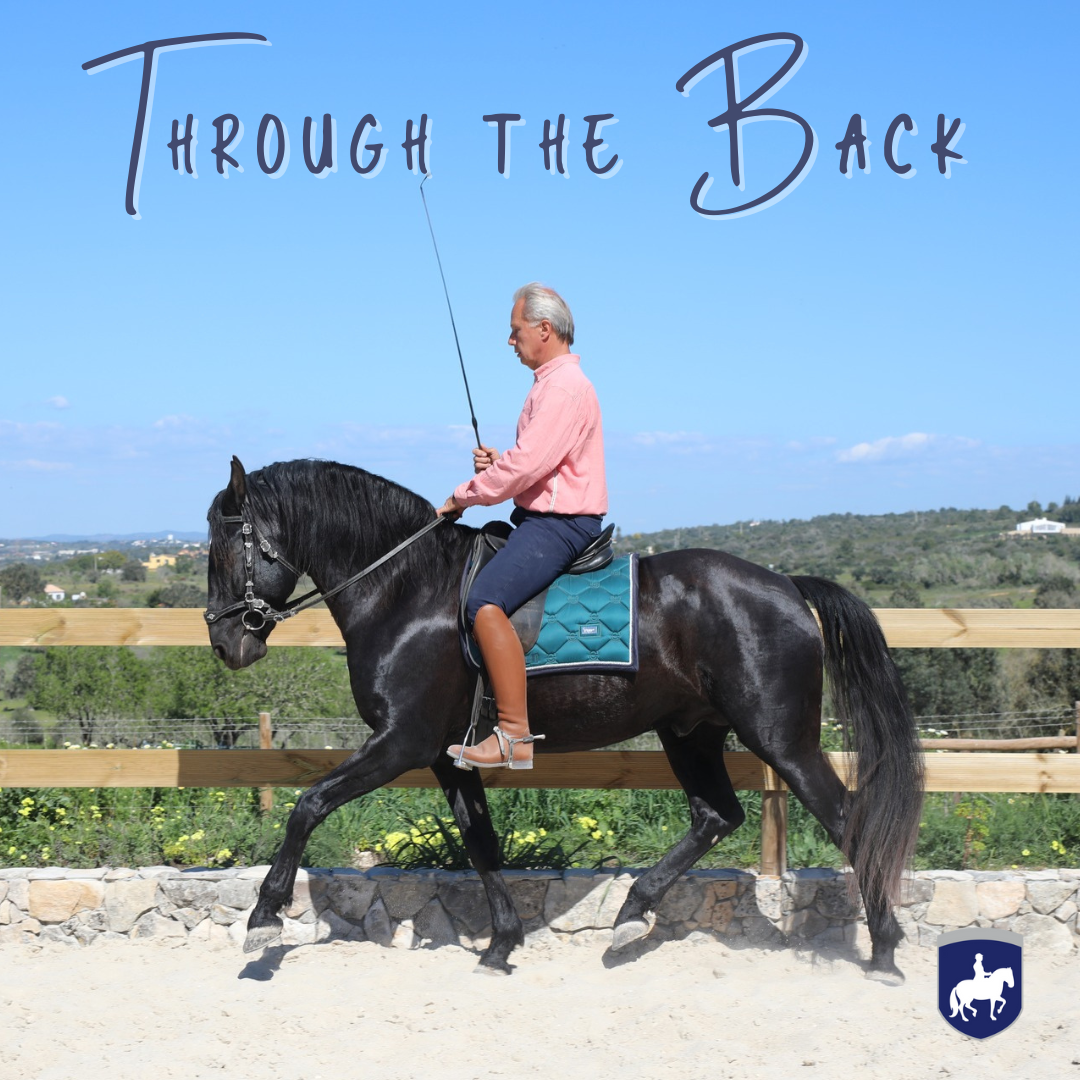
The swinging movement and energy connection that are the result of a horse working properly through the back create a feeling you will never forget. Choose exercises and arena patterns that encourage the horse to engage and flex his hind legs, and remember to use your seat in a dynamic way that supports the horse’s movement, so that he is able to lift his back, engage his hind legs, flex his hind legs, and push off again with them in a forward-upward direction.

The 8 Different Types Of Exercises

The 8 Different Types Of Exercises

You can make the training easier and better understandable for the horse if you try to look at it from the horse’s point of view. Ask yourself what it is you are asking the horse to do in physical, biomechanical terms. Find out which elementary skills your horse needs to possess and which elementary types of movements he has to be able to do in order to perform a certain movement. Then try to build him a ladder of small learning steps that teach him those elementary skills that he is still lacking. Try to utilize the principle of the economy of motion whenever possible, i.e. lead the horse down a path where the movement or transition you want to ride appears to be the most energy conserving thing the horse could do under the circumstances.


Inside Leg to Outside Rein

Inside Leg to Outside Rein

What does it mean to ride from the inside leg to the outside rein? And how do I do that?
Inside leg to outside rein is an abbreviation for a relatively complex set of movement patterns that result in a very supple, balanced, straight, and agile horse. The job of the inside leg is to initiate the circle of aids by bringing the inside hind leg closer to the outside one as well as closer to the front legs. This results in a weight shift from the inside shoulder onto the outside pair of legs, which results in an expansion and stretch of the muscles on the outside of the horse’s bend, this in turn creates a contact with the outside rein, which is then able to connect back to the outside hind leg.


The Principle of the Economy of Motion

The Principle of the Economy of Motion

There is a general tendency in all living beings to conserve energy, to avoid conflict if possible, and to travel the path of the least resistance. When they move, they try to do so in the most comfortable manner and with the least possible expenditure of strength and energy (they are only human, too).

Water seeks the lowest energy level by flowing downhill, through openings, and around obstacles. Electricity always seeks the path of the least resistance. It’s a natural law that you can observe every day in countless manifestations.

8 Habits Of Highly Successful Riders

8 Habits Of Highly Successful Riders

8 habits that will make you a successful rider. If you prioritize the items on this list, you and your horse will progress, slowly but surely. Whenever you feel lost or frustrated, return to this list, check if you have been implementing it or if you have become sloppy with some of these items. If you put one foot in front of the other, you will succeed step by step, even if progress sometimes seems to be painfully slow for all of us.


Polishing the Pebble

Polishing the Pebble

Not everything in riding is glamorous. Not everything is special, magical, and brilliant.

Much of the most important work we do, as riders, is work that is simple - even mundane - in its simplicity. But it is where the real treasures lie.

It is one thing to teach a horse a new concept, movement, or skill set. This is important work, too, but at first, it will come with many rough edges. When you introduce it to the horse, you get it in its crude, unpolished form. It is far from “finished” and the real work unfolds from there.

Some Thoughts About Energy

Some Thoughts About Energy

Energy is not an official part of the training pyramid. It’s not really a formal category of training, although teachers will sometimes ask students to ride a more energetic walk, trot, or canter. I suspect that when teachers tell the students to “ride more forward” they often mean “create more energy”, but the word “forward” tends to lead to more speed, rather than more energy or more power.

The closest thing in the official terminology is Schwung/Impulsion, but it’s not quite the same as energy.

The Relaxed Walk at the Longe Line

The Relaxed Walk at the Longe Line

You can communicate so much in a subtle way to the horse at the walk. You can influence better the bend, carriage, size of the circle, and rhythm/tempo if you begin by establishing it at the walk. But not every horse is so keen to walk at the beginning of the work session, I know! They have to learn through gentleness, calm groundedness, and guidance. Once they learn how then it becomes a habit.